
What You Can Build
From rapid prototyping to production-scale apps — the API adapts to every use case.

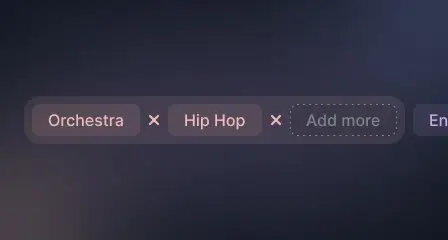
Multi-Genre Mixing
Dynamic Soundtracks

Unique Track Discovery

Rapid Prototyping
Sample AI-Generated Tracks
Illustrative demos for style and quality. Each clip is a preview, not a popularity or usage statistic.

Love Unlocked
PopNever gonna give you up

Shattered
Progressive-MetalGenerate a progressive metal track with complex time...

Arrival
Pop-HeartfeltCreate a song about hollow knight silksong finally being...

Elite Crew
Hip-HopCreate a song about a monkey, called pipinu, a cat called...

十八岁的自由
Upbeat年满十八岁,对即将迎来的自由感到期待...

Strange Faces
SoftMake a dubstep track with heavy bass drops and glitch...

Twist
ElectronicAn electronic twist with unexpected rhythms

Drift Away
AmbientEthereal ambient textures that float between dream and reality

Harder Road
RockA rock anthem about perseverance and grit

Peculiar Change
Jazz-FusionJazz-fusion exploration with shifting harmonies
Everything You Need to Build
A complete platform for integrating AI music generation into your products.
Lightning Fast
Optimized inference pipeline delivers generated audio in seconds. Async webhooks available for longer compositions.
Multi-Model Access
Stable Audio, MusicGen, and more — switch between leading AI music models with a single parameter change.
Enterprise Security
End-to-end encryption, SOC 2 compliant infrastructure, and fine-grained API key permissions for your team.
Global Edge Network
Requests routed to the nearest edge node for the lowest possible latency, wherever your users are.
Usage Analytics
Real-time dashboard with generation metrics, cost tracking, and usage alerts to keep your budget in check.
Full Audio Control
Control genre, mood, tempo, duration, and instruments. Fine-tune every aspect of the generated music.
Get Started in 4 Steps
From sign-up to your first generated track in under 5 minutes.
Create Your Account
Sign up for free and get your API key instantly from the dashboard. No credit card required to start.
Choose a Model
Select from supported models. Each model offers different strengths — our docs help you pick.
Send Your First Request
Make a POST request with your prompt, model, and parameters. Get back a task ID for status polling or use webhooks.
Download and Use
Retrieve the generated audio URL once processing completes. Use it in your app, game, video, or any project.
Frequently Asked Questions
Everything you need to know about the AI Music API.
What is the AI Music API?
The AI Music API is a unified REST API that gives developers access to multiple AI music generation models from different providers. Instead of integrating each provider separately, you use one API with a consistent interface.
How does pricing work?
We offer a generous free tier to get started. Paid plans use a credit-based system — each generation costs a fixed number of credits depending on the model and duration. See our pricing page for details.
What audio formats are supported?
Generated audio is delivered in MP3 format by default. Some models also support WAV and FLAC output. The format can be specified in your API request.
Do I own the music I generate?
Yes. All music generated through the API is fully licensed for commercial use. You retain full ownership and can use it in any project without royalty fees.
What models are available?
We currently support Stable Audio, MusicGen, and other leading models. We continuously add new models as they become available.
Is there a rate limit?
Free tier accounts have a rate limit of 10 requests per minute. Paid plans offer higher limits based on your subscription level, with enterprise plans offering custom rate limits.
How long does generation take?
Most tracks generate in 30–120 seconds depending on the model and duration requested. We provide async polling and webhook endpoints so you don't have to block your application.
Can I use this for commercial projects?
Absolutely. All paid plans include full commercial usage rights. You can use generated music in apps, games, videos, podcasts, and any other commercial project.
What programming languages are supported?
The API is a standard REST API with JSON payloads, so it works with any programming language — Python, JavaScript, Go, Ruby, Java, C#, and more. We provide official SDKs for Python and JavaScript.
How do I get support?
All users get access to our comprehensive documentation and developer community. Paid plans include priority email support, and enterprise plans include dedicated support with SLA guarantees.
Can I generate lyrics alongside the music?
Yes. Several supported models can generate vocals with lyrics. Simply include a lyrics parameter in your request, or let the AI compose lyrics based on your prompt.
What is the maximum song duration?
Duration limits vary by model. Most models support up to 2–4 minutes per generation. You can extend tracks by using the continuation or extend endpoint to append additional segments.
Is there a sandbox or test environment?
Yes. Your free tier functions as a sandbox. All API endpoints work identically in free and paid modes — the only difference is rate limits and monthly generation caps.
How do webhooks work?
Register a webhook URL in your dashboard. When a generation completes (or fails), we send a POST request to your URL with the task result, so you don't need to poll our status endpoint.
Can I fine-tune or train custom models?
Custom model training is not currently available through the API. However, you can achieve highly specific results by combining detailed prompts with genre, mood, and instrument parameters.
What happens if a generation fails?
Failed generations do not consume credits. You will receive an error response with a descriptive message. Our system automatically retries transient failures before returning an error to you.
AI Music API is an independent service: we provide a unified developer interface to third-party AI music models. We are not affiliated with, endorsed by, or sponsored by any particular model provider. Names of models in docs describe compatibility only. For acceptable use and content rules, see our Terms and Content Safety pages.